
Loading your page…
Loading your page…
Published by Korean Association of Cardiopulmonary Resuscitation · GRADE / GRADE-ADOLOPMENT
This clinical guideline describes the update process and key highlights of the 2025 Korean Guidelines for Cardiopulmonary Resuscitation (CPR). Developed using the GRADE and GRADE-ADOLOPMENT methodologies, it introduces significant updates across basic life support, advanced life support, post-cardiac arrest care, pediatric and neonatal resuscitation, education, and first aid.
Key Takeaways
Key changes from the 2020 guidelines include: 1) Addition of rehabilitation and recovery as a fifth link in the chain of survival; 2) Combination of advanced life support and post-cardiac arrest care into a single link; 3) Dispatcher guidance on AED location and placement (including underwear adjustment guidance for female patients); 4) Rescue breaths first for drowning; 5) Double sequential/vector-change defibrillation for refractory VF; 6) Revision of target temperature range from 32-36 °C to 33-37.5 °C; 7) Layperson AED use for children >= 1 year; 8) Supraglottic airway and video laryngoscopy in neonatal resuscitation; 9) Feedback devices in training and discouraging asynchronous online learning as a routine substitute for traditional training; 10) Addition of a dedicated first aid section addressing cardiac arrest-related emergencies (such as chest pain, stroke, asthma, anaphylaxis, shock).
Emergency dispatchers are recommended to guide callers in locating and applying an AED.
AED pads should be applied to the bare chest, with adjustment of underwear without removing the bra in female patients.
Trained first responders and healthcare providers are advised to initiate resuscitation with rescue breathing for drowning victims.
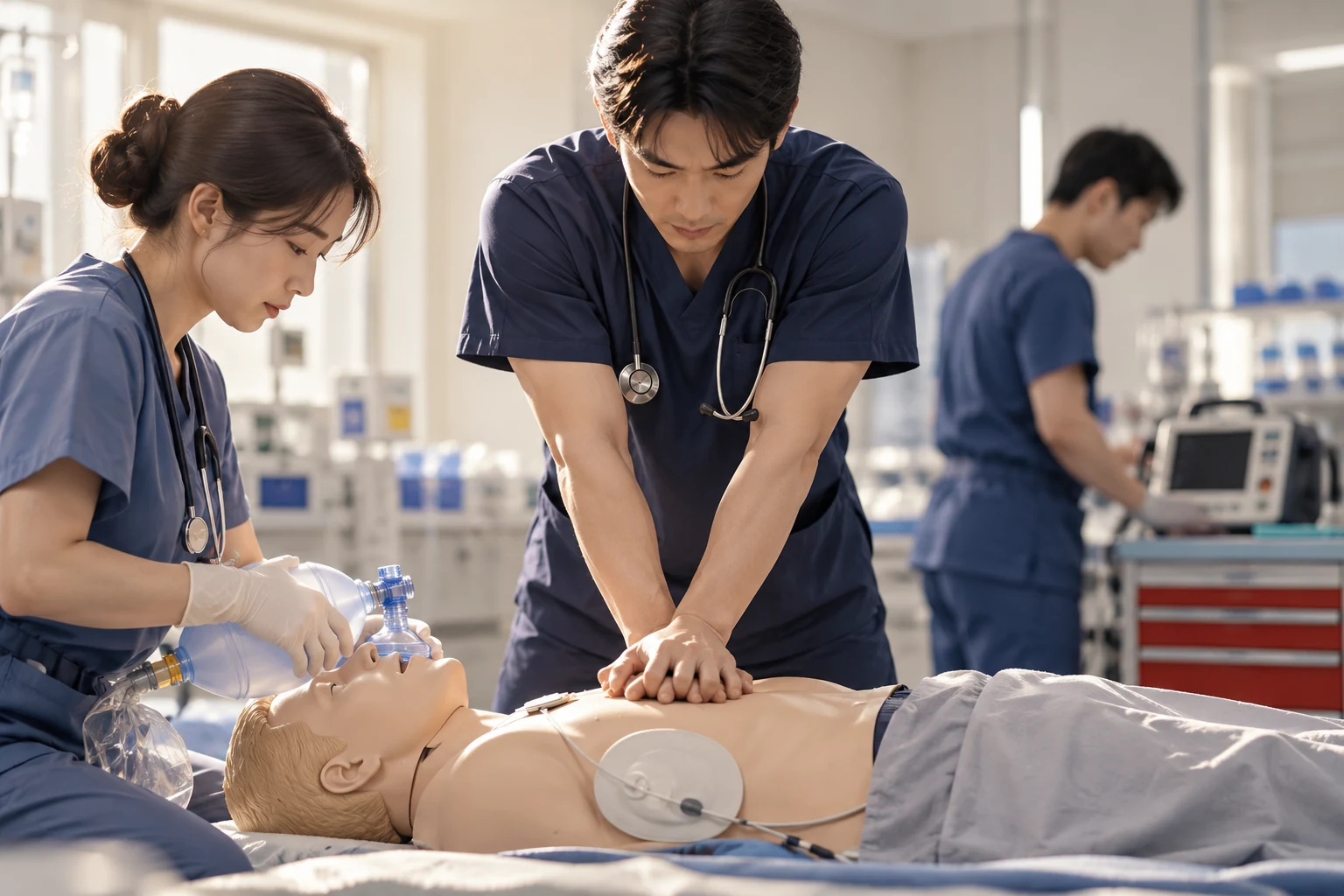
During chest compressions, rescuers are advised to place their dominant hand in the lower position.
The chest compression fraction should be maintained at least 60% and as high as possible.
For ventilation, a simplified rate of one breath every 6 seconds (10/min) is recommended.
For adult patients with cardiac arrest and refractory shockable rhythms, trained healthcare providers are advised to consider double sequential defibrillation or vector-change defibrillation when additional pads or defibrillators are immediately available.
Routine use of vasopressin and corticosteroids as adjuncts to standard CPR, as well as routine administration of buffers, including sodium bicarbonate, or calcium is not recommended during resuscitation.
Prone CPR is suggested for patients who experience cardiac arrest in the prone position and have an advanced airway in place when immediate repositioning to the supine position is not feasible or poses additional risk.
Targeted temperature management is recommended for comatose patients after return of spontaneous circulation, with the target temperature maintained at 33 to 37.5 °C for at least 24 hours.
For infants, both lay rescuers and healthcare providers are recommended to use the two-thumb chest compression technique with both hands encircling the chest, regardless of the number of rescuers, rather than the two-finger technique.
Layperson defibrillation is recommended for children aged 1 year and older.
Clinical Topic
Cardiopulmonary Resuscitation
Objectives
To improve survival and neurological outcomes after cardiac arrest by providing evidence-based CPR guidelines adapted to the Korean context.
Target Patient Population
Patients experiencing cardiac arrest or cardiac-arrest-related emergencies (including adults, children, infants, and neonates).
Target Providers
Therapeutic Area
Emergency MedicineGuideline Scope
Inclusion Criteria
Care Settings
Special Populations
System: GRADE / GRADE-ADOLOPMENT
Evidence Levels
Recommendation Strength
Contraindications
Monitoring Guidance
Includes guidance on monitoring during CPR (e.g., breathing, pulse, physiological monitoring, feedback devices) and specific post-resuscitation monitoring targets (MAP of at least 60 to 65 mmHg, SpO2 of 94% to 98%, PaCO2 of 35 to 45 mmHg, blood glucose of 144 to 180 mg/dL, and temperature maintained at 33 to 37.5 °C).
Difficulty
advanced
Learning Paths