
Loading your page…
Loading your page…
Published by Korean Association of Cardiopulmonary Resuscitation · GRADE (Strong/Weak recommendations, level of certainty)
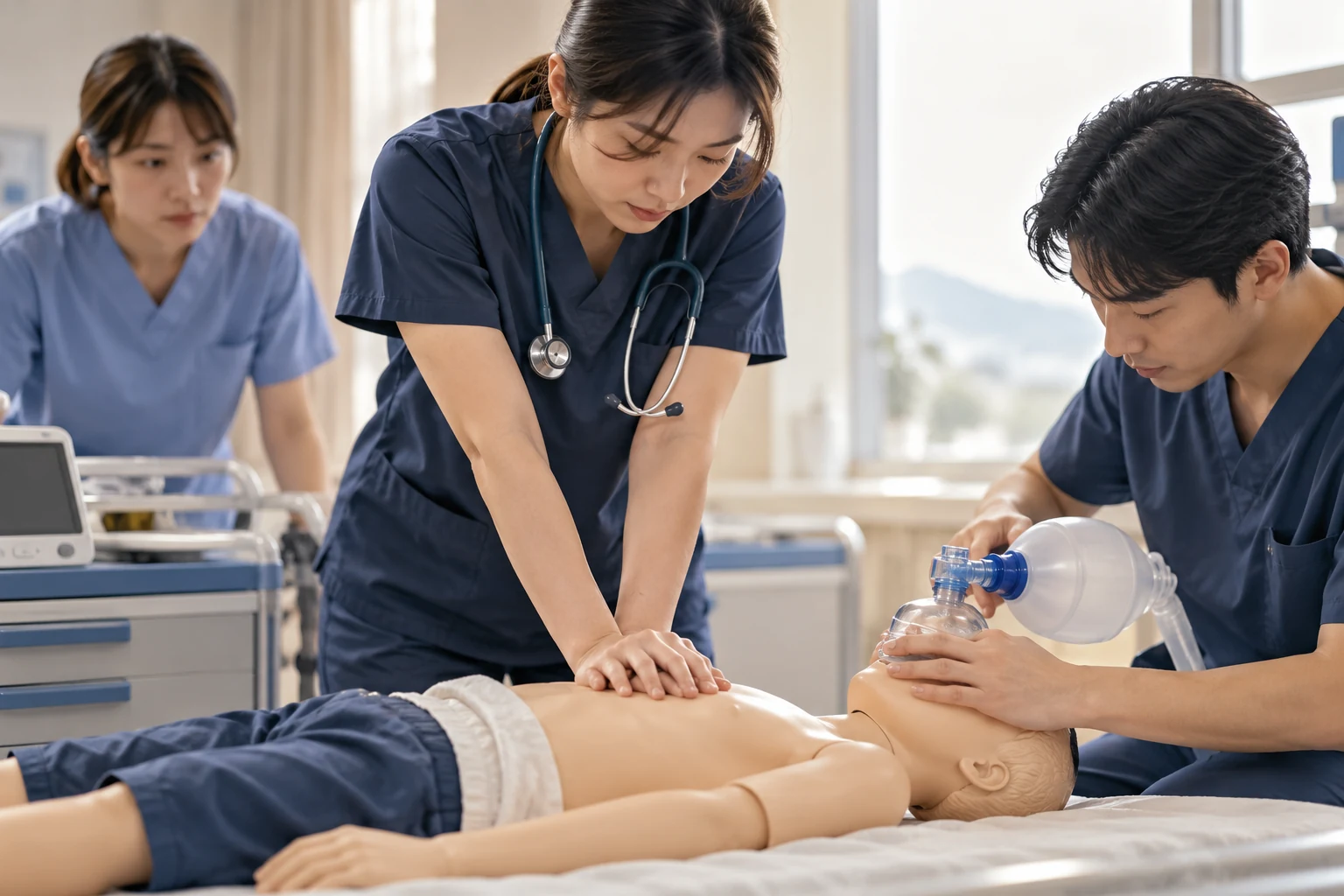
The 2025 Korean Guidelines for Pediatric Basic Life Support detail updated, evidence-based practices for resuscitating infants and children. Key updates include the strong recommendation for all rescuers to use the two-thumb encircling hands technique for infant chest compressions, the implementation of pediatric early warning systems (PEWS) in hospitals, the approved use of AEDs by lay rescuers for children over 1 year of age, and alternating 5 back blows with 5 chest thrusts for choking infants.
Key Takeaways
Four major updates were introduced in 2025: (1) Implementation of pediatric early warning systems (PEWS) in hospitals; (2) Universal recommendation of the two-thumb encircling hands technique for infant chest compressions by all rescuers; (3) Suggestion for lay rescuer AED use in children aged 1 year or older with nontraumatic OHCA; (4) Specific guidance to alternate five back blows and five chest thrusts (using the heel of one hand) for infant foreign body airway obstruction.
It is suggested to implement pediatric early warning systems (PEWS) to facilitate early recognition of clinical deterioration in hospitalized children.
For all rescuers (lay and healthcare providers), the two-thumb encircling hands technique is recommended for chest compressions in infants regardless of the number of rescuers. One-hand compression may be considered when this technique cannot be performed, or when the infant's body habitus and weight are close to those of a 1-year-old, but it is not recommended as the first choice.
For nontraumatic out-of-hospital cardiac arrest (OHCA) in children aged 1 year or more, the use of automated external defibrillators (AEDs) by lay rescuers is suggested.
Five back blows and five chest thrusts should be alternated to relieve foreign body airway obstruction in infants and repeated until the foreign body is expelled or the infant becomes unresponsive; chest thrusts should be delivered using the heel of one hand.
Bag-mask ventilation is more reasonable for ventilation in pediatric patients with OHCA compared to advanced airway insertion (endotracheal intubation or supraglottic airway).
Clinical Topic
Pediatric Basic Life Support
Objectives
To provide updated, evidence-driven guidelines for pediatric basic life support, aiming to enhance bystander intervention, CPR quality, and survival with favorable neurologic outcomes.
Target Patient Population
Infants and children under 8 years of age
Diagnostic Criteria
Unresponsiveness with absent or abnormal breathing (e.g., gasping). For healthcare providers, additionally checking for a pulse within 10 seconds; starting compressions if pulse is absent or <60 beats/min with signs of poor perfusion.
Target Providers
Therapeutic Area
Cardiopulmonary ResuscitationGuideline Scope
Care Settings
Special Populations
System: GRADE (Strong/Weak recommendations, level of certainty)
Contraindications
Monitoring Guidance
Implement Pediatric Early Warning Systems (PEWS) to monitor vital signs like blood pressure, pulse, respiratory rate, temperature, oxygen saturation, and consciousness level for early warning of deterioration in inpatient settings.
Difficulty
intermediate
Learning Paths