
Loading your page…
Loading your page…
Published by Department of Veterans Affairs and Department of Defense · GRADE (Grading of Recommendations Assessment, Development, and Evaluation)
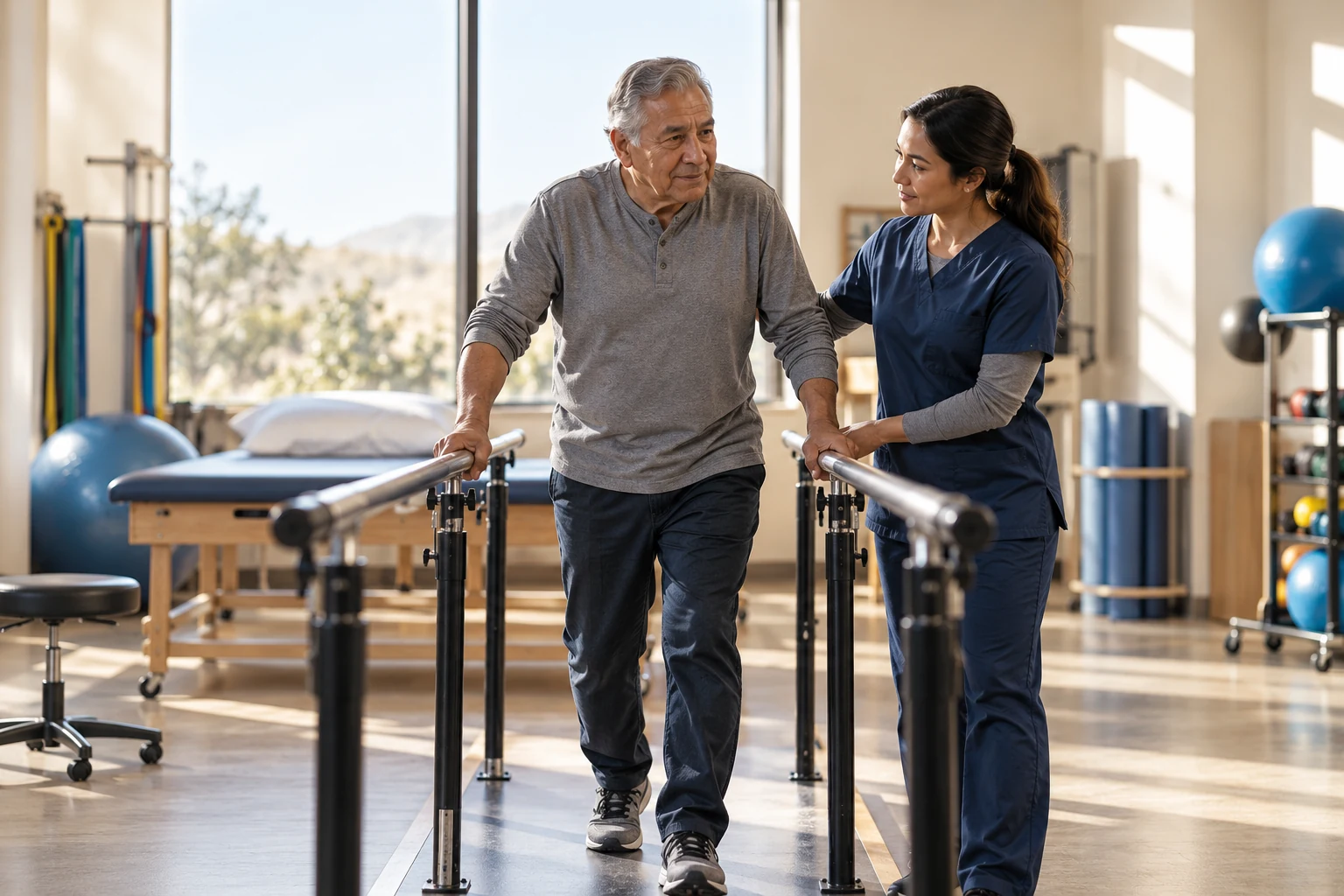
This clinical practice guideline provides an evidence-based framework for the rehabilitation of adult stroke survivors, addressing transitions to community, motor therapy, dysphagia, aphasia, spatial neglect, and mental health complications.
Key Takeaways
Added 24 new recommendations, replaced 19, amended 3, and deleted 16 recommendations from the 2019 CPG. Refined the use of GRADE methodology and expanded literature searches into complementary and integrative health, spasticity management, and technology-based modalities.
We suggest using case management services at time of discharge from the acute care hospital or post-acute care facility to improve activities of daily living and functional independence.
We suggest the following interventions for patients and their caregivers: Behavioral health/psychosocial interventions to improve patient and caregiver depression; Psychoeducation to improve family function, patient functional independence, and quality of life.
There is insufficient evidence to recommend for or against implementing transitional care rehabilitation interventions (e.g., home-based services after hospital discharge) or early supported discharge to improve activities of daily living or functional disability following stroke.
There is insufficient evidence to recommend for or against community participation interventions to improve community engagement for survivors of stroke.
We recommend task-specific practice (also known as task-oriented practice or repetitive task practice) to improve motor function, gait, posture, and activities of daily living.
We suggest mirror therapy to improve motor outcomes and activities of daily living.
We suggest mirror therapy to improve unilateral spatial neglect.
There is insufficient evidence to recommend for or against body-weight support treadmill training to improve motor outcomes.
We suggest rhythmic auditory stimulation as an adjunct intervention to improve motor outcomes.
There is insufficient evidence to recommend for or against the use of high intensity interval training over moderate intensity continuous training to enhance gait recovery.
There is insufficient evidence to recommend for or against constraint-induced movement therapy to improve upper extremity motor outcomes for individuals with some movement in the paretic limb.
There is insufficient evidence to recommend for or against selective serotonin reuptake inhibitors to improve motor outcomes in patients with or without depression.
There is insufficient evidence to recommend for or against aquatic therapy, as compared with land-based therapy, to improve mobility, balance, and activities of daily living.
There is insufficient evidence to recommend for or against biofeedback as an adjunct intervention to improve motor outcomes.
There is insufficient evidence to recommend for or against motor imagery to improve motor function.
There is insufficient evidence to recommend for or against acupuncture to improve motor function.
We suggest neuromuscular electrical stimulation to improve motor outcomes.
There is insufficient evidence to recommend for or against robot-assisted therapy to improve upper or lower extremity motor outcomes.
There is insufficient evidence to recommend for or against virtual reality to improve balance or enhance gait recovery.
There is insufficient evidence to recommend for or against the use of virtual reality/serious gaming to improve upper extremity motor outcomes, activities of daily living, or quality of life.
There is insufficient evidence to recommend for or against contralaterally controlled functional electrical stimulation to improve upper extremity motor outcomes and activities of daily living.
There is insufficient evidence to recommend for or against non-invasive brain-computer interface to improve upper extremity motor outcomes and activities of daily living.
There is insufficient evidence to recommend for or against vagus nerve stimulation as an adjunct intervention for rehabilitation of acute and chronic motor deficits.
We suggest botulinum toxin for patients with focal spasticity depending on patient characteristics and preferences.
There is insufficient evidence to recommend for or against the use of acupuncture or dry needling for spasticity management.
There is insufficient evidence to recommend for or against whole body or localized muscle vibration for spasticity management.
There is insufficient evidence to recommend for or against extracorporeal shock wave therapy for spasticity management.
We suggest chin tuck against resistance exercises for patients with dysphagia.
We suggest respiratory muscle strength training for dysphagia in patients without a tracheostomy.
There is insufficient evidence to recommend for or against tongue pressure resistance training for dysphagia.
There is insufficient evidence to recommend for or against neuromuscular electrical stimulation and pharyngeal electrical stimulation for dysphagia.
There is insufficient evidence to recommend for or against surface electromyography for dysphagia.
There is insufficient evidence to recommend for or against the use of selective serotonin reuptake inhibitors to improve cognitive outcomes.
There is insufficient evidence to recommend for or against computer assisted cognitive rehabilitation to improve cognitive outcomes.
There is insufficient evidence to recommend for or against a specific intensity of language therapy for aphasia.
There is insufficient evidence to recommend for or against hemifield eye patching in addition to traditional therapy to improve functional outcomes in patients with unilateral spatial neglect.
There is insufficient evidence to recommend for or against the use of prism adaptation therapy for patients with unilateral spatial neglect.
There is insufficient evidence to recommend for or against solution-focused psychological interventions (e.g., motivational interviewing, problem-solving therapy) to prevent the development of depression.
We suggest against the use of antidepressants for the prevention of post-stroke depression.
We suggest a selective serotonin reuptake inhibitor or a serotonin norepinephrine reuptake inhibitor for depression symptoms.
We suggest psychotherapy (e.g., cognitive behavioral therapy) for depression following stroke.
We suggest mindfulness-based therapies for treatment of depression following stroke.
There is insufficient evidence to recommend for or against acupuncture, either alone or as an adjunct to pharmacotherapy, for depression following stroke.
We suggest either face-to-face therapy or telerehabilitation, depending on patient characteristics and preferences.
There is insufficient evidence to recommend for or against the use of telerehabilitation and technology-based interventions to improve stroke-related dysphagia or aphasia outcomes or both.
There is insufficient evidence to recommend for or against technology-based caregiver support/education interventions to improve caregiver quality of life.
There is insufficient evidence to recommend for or against non-invasive brain stimulation (e.g., repetitive transcranial magnetic stimulation, transcranial direct current stimulation, and continuous theta burst stimulation) for patients in stroke rehabilitation.
Clinical Topic
Stroke Rehabilitation
Objectives
To provide an evidence-based framework for evaluating and managing care for adult patients who have experienced a stroke, toward improving clinical outcomes.
Target Patient Population
Adult patients (18 years and older) who have experienced a stroke
Target Providers
Therapeutic Area
Neurology and RehabilitationGuideline Scope
Inclusion Criteria
Exclusion Criteria
Care Settings
Special Populations
System: GRADE (Grading of Recommendations Assessment, Development, and Evaluation)
Evidence Levels
Recommendation Strength
Contraindications
Monitoring Guidance
Assess the patient and identify rehabilitation goals; continue treatment and reassess periodically to determine if goals are met or a plateau is reached.
Difficulty
advanced
Learning Paths